GEPS Campaigning Issues for 2026
Matter 1 – Expand Seven Mile Beach National Park to support the Greater glider population and protect endangered species and communities
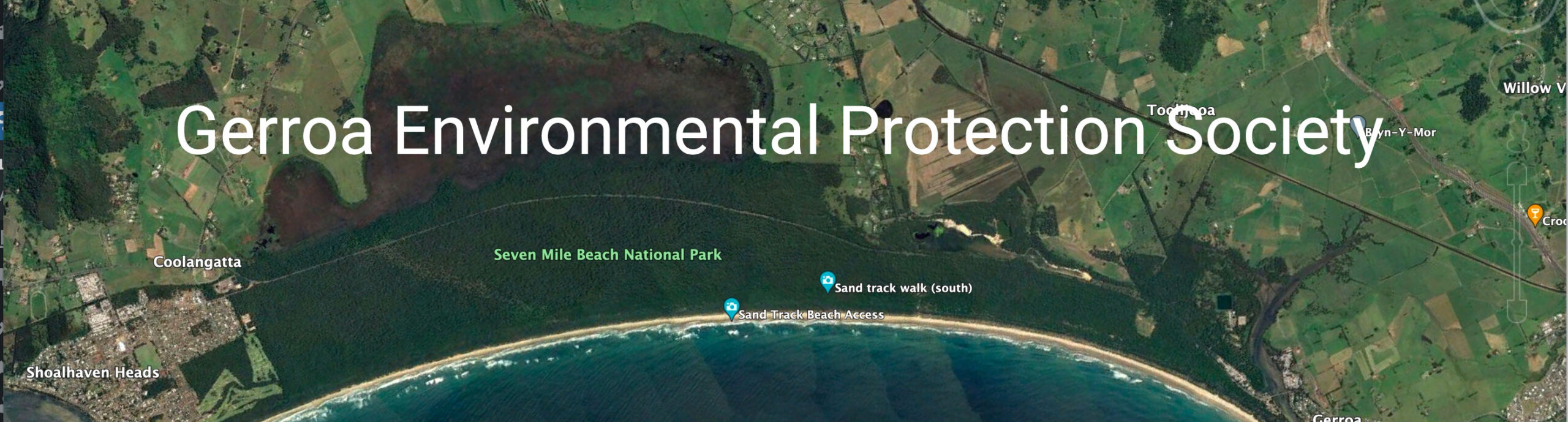
In 2021 GEPS nominated the habitat at Seven Mile Beach (SMB) to be recognised as Area of Outstanding Biodiversity Value (AOBV). This nomination was underpinned by 16 studies specific to SMB and describes environmental values, including 13 endangered and threatened species and 8 endangered ecological communities.
Since this nomination, important studies provide a better understanding of the significance of the endangered Greater glider population at Seven Mile Beach. They outline how Greater gliders have suffered severe declines across all south coast National Parks except for Seven Mile Beach National Park.
Given the documented high environmental values outlined in GEPS AOBV nomination and new information about the decline of endangered Greater gliders, GEPS is campaigning for the expansion of GG habitats to incorporate crown land reserves and adjoining private lands into an expanded SMB National Park.
For further detail click here.
Matter 2 – Require Department of Planning to do its job
In GEPS 2008 Land and Environment Court (LEC) challenge, Judge Preston required sand mining company Cleary Bros to enter into a Planning Agreement to conserve in perpetuity a significant area of compensatory habitat at Seven Mile Beach. This Condition of Consent has never been implemented.
GEPS is campaigning to require the Department of Planning to comply with the conditions of consent to implement the Planning Agreement to conserve vegetation at SMB.
For further detail click here.
Matter 3 – One of the biggest biodiversity conflicts in the State
At the Dunmore Hard Rock Quarry, Boral has been granted consent to clear 8 ha of the Critically Endangered Ecological Community, Melaleuca Armillaris Tall Shrubland and to remove of 1,381 endangered Zieria granulata plants.
This Critically Endangered Community is one of the most threatened vegetation communities in the State with only 164 ha surviving, while Zieria Granulata is a local endangered plant species with an estimated total population of only 8,000 plants.
It’s important to note that Between 2011 and 2024 the area of Critically Endangered Melaleuca armillaris Tall Shrubland has more than halved from 390 ha to 164 ha.
GEPS is campaigning for:
- remaining Melaleuca armillaris Tall Shrubland habitats in Jamberoo and Dunmore to be protected and managed within new conservation or nature reserves
- the development of a Recovery Plan for this Critically Endangered Ecological Community.
- an investigation to determine if any mining companies or landholders have illegally cleared this CEEC
- Landcare or Biodiversity Conservation Trust grants to support Kiama Council with the recovery of Zieria granulata at the Jerrara Dam site
For further details click here
Matter 4 – Incomprehensible planning decision by Kiama Council
Kiama Council Seven Mile Beach Crown Lands Plan of Management (POM) inappropriately categorises the hind sand dunes along Seven Mile Beach as ‘Park’, a category intended to enable the community to participate in passive recreation including the casual playing games.
Most Council discourage trampling of hind dunes to encourage dune vegetation to colonise and stabilse the dunes. At Gerroa it is important to protect the breeding sites of the endangered Oyster catchers (refer to supporting information sheet).
GEPS is campaigning for the hind dunes, to be recategorised as ‘Natural Area’ in the POM because the ‘Natural Areas’ category has objectives to maintain the land in its natural state and to provide for the restoration and regeneration of the land.