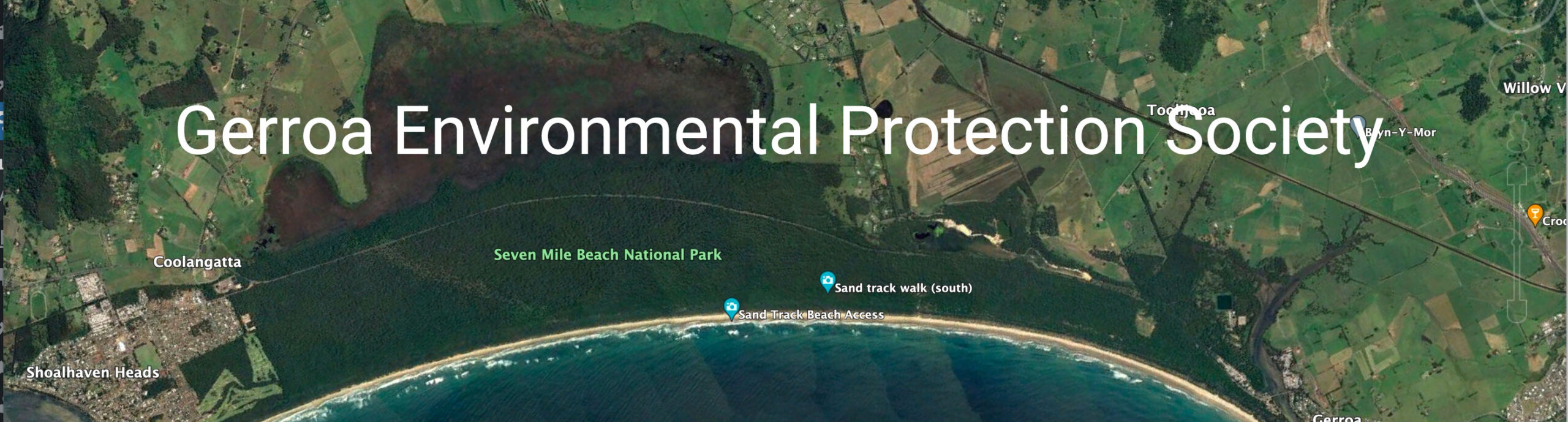
Matter 1 – Expansion of Seven Mile Beach National Park
Expand Seven Mile Beach National Park to incorporate endangered greater glider habitat in adjoining Crown and privately-owned lands
This concern relates to the need to better protect the greater glider habits at Seven Mile Beach by expanding the area of GG habitat in the NP
Greater gliders are experiencing widespread decline across their distribution. They are obligate cavity dependent folivores with poor thermotolerance and high susceptibility to fragmentation and fire. These characteristics put greater gliders at high risk of further decline and extinction. Conservation of all populations are crucial to the species’ persistence. (Mulley 2022)

Background information
In 2021 GEPS submitted a nomination for the habitat at Seven Mile Beach to be recognised as Area of Outstanding Biodiversity Value (AOBV). This nomination is underpinned by 16 studies and Plans specific to SMB and describes the environmental values of the SMB area, which includes 13 endangered and threatened species and 7 Endangered ecological communities. It can be used as a reference for scientifically documented environmental values of SMB that are found in the NP and on Crown and adjoining privately-owned lands.
Greater glider
Since GEPS AOBV nomination was submitted, important studies by Daly and Mulley provide a better understanding of the significance of the endangered Greater Glider at Seven Mile Beach.
Daly (2025) provides evidence that SMB is most likely the last stronghold of the greater glider on the south coast, He documents how greater gliders have suffered severe declines in abundance and distribution across all South Coast National Parkes, except for Seven Mile Beach NP, where populations remained unchanged. He states that the long-term persistence of greater gliders in the Jervis Bay area and within South Coast National parks is not assured due to a range of on-going threats.
He references the minimum habitat required for a sustainable Southern Greater Glider population as 1000ha. He also explains that while SMB NP is less than the minimum habitat area required to sustain a viable population there is adjoining freehold and council managed lands (c. 427ha) that in combination exceeds the calculated minimum size for viability .
Mulley (2022) found that the Southern Greater Glider population in Seven Mile Beach NP has a poor viability and high extinction risk, exhibiting minimal chance of persistence for the next fifty years.
GEPS concerns
Over 80 ha of Endangered vegetation including greater glider habitat has been cleared in relation to sand mining at Seven Mile Beach. We are concerned that important Greater glider habitat on private land southwest of the Gerringong STP corresponds with an identified sand resource.
We are very concerned that an application to mine into endangered vegetation/glider habitat could be lodged when the current Gerroa sand mine is exhausted.
We are also concerned that vegetation on Crown Land at Shoalhaven Heads (Reserve 1003018) is at risk of clearing and development. (In a 2001 Gazettal this was land set aside for the purpose of public recreation and environmental protection). About half the land was controversially cleared for the Shoalhaven Heads golf course and the remaining vegetation is at risk due to an urban zoning.
Request:
Given this new information about the decline in greater glider populations on the South Coast and the importance of conserving an area of GG habitat capable of sustaining a viable population at SMB, we would like you to support an investigation into the expansion of GG habitats within SMB NP. This could include incorporating crown land reserves and adjoining private lands that are covered by new conservation agreements.
Howard Jones (GEPS secretary)
hhjones@westnet.com.au
0434400466